
Crossing Your t's and Dotting your i's

*Updated*

  1. Practice your eighth note alternating strumming (up and down strokes) with your F and B chord progressions. Make sure your wrist is moving fluidly as a part of your strumming motion. Stay mindful of how you're playing your chords and make sure you're reinforcing the correct forms for your fingers and hands to better establish your muscle memory.
  2. Make sure you're using the correct fingers for each note as you keep working on your note exercise pages going from, "B and E String Review" to, "Beautiful Brown Eyes" (including track 8-12 in between). The F, G, and A notes on the E string should be played with fingers 1, 2, and 4 respectively. Notes C and D on the B string should be played with fingers 1 and 3 respectively using the normal Four Fingers Four Frets technique we'll try to stick to most of the time. 
  3. Practice in chunks using the Rule of Five to the metronome every time you practice, and gradually build up your chunks until you end up with the complete exercise. The chunks will go faster thank you think if you take them seriously and will save you more time in the long run. Take time to save time!
  4. Take turns with who plays the chords and who plays the melody. The person playing the melody should switch to singing the lyrics of the exercise instead of the note names once you progress through your chunks to practicing the whole exercise.
  5. Whoever is working on the melody should always be singing, and loudly.
  6. Don't forget to practice to the metronome all the time! All these little steps are important in instilling various concepts into your subconscious so that they become automatic and can be built on later. Cutting corners might seem fun in the moment but will cost you time, progress, and ability and in reality will result in a less satisfying and fun experience in the long run. Take time to save time! You'll have more fun as you become more fluent and capable, and quality practice will get you there faster and in better shape.
Digging Deeper into Theory

  1. Try to think about about your chordal theory as you practice in relation to the chord progressions and note exercises.
  2. Make sure to start on the 1 when practicing to your metronome.
  3. Watch your wrist, hand, and finger positions and make sure you're trying to keep them in the orientations we discussed for any chords you have trouble with. Always build from low to high!
  4. Keep working on your new chords, F, B5, and B major.
  5. Practice the new chord progressions that we wrote for our F and B chords.
  6. Keep the crease of your palm inline with the apex of the back of the neck when using the grip form for open chords with your thumb coming around the outside of the neck.
  7. Look over our notes regarding chordal theory, how triads are built from stacks of 3rds and so on, so you can continue to digest those concepts and consider how they relate to the actual things you're working on in your practice.
  8. Keep working on the single note exercise pages you have, alternating from playing the rhythm (chords), to the melody (single notes). Don't forget to sing along when you're playing the single note melody parts. Sing loud!
  9. Always remember to build any chords from low to high in terms of pitch until you have them down to essentially a single movement for all fingers.

Learning to Give an F (chord)

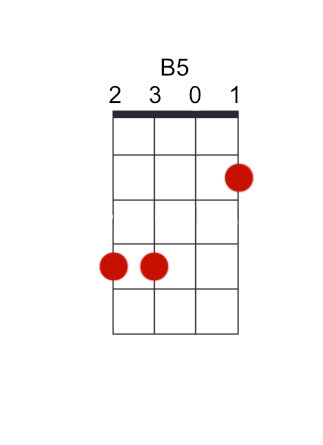
  1. Practice your new chords F and B5 which will come up in your new sheets of music (diagram for B5 will be below).
  2. Make sure to sing loudly and try to keep your jaw open wide to let the sound and air out.
  3. Try to keep your eyes on the music when practicing the note exercises as much as possible. You shouldn't look at your right (strumming/picking) hand at all, and you should look at your left fretting hand seldom, mostly when shifting (which we aren't really doing yet). Remember that your hands are more capable than you're giving them credit for when operating by feel and sound, but you have to learn to trust them to take advantage of that ability.
  4. Write 2-3 new chord progressions incorporating your new chords.
  5. Stick to the fingering in the diagram for your new B5 chord as it will set us up to learn a normal B major chord later.
Baritone Uke B5.jpg

Learning to Sing

  1. Keep working on your single note sheets, singing the letter notes loud as you play, and practicing slowly to the metronome in chunks using the Rule of Five.
  2. Make 2 new chord progressions using at least six different chords with two different chords within each measure. Kett, try to make a progression that you think sounds good.
  3. Remember to play on your fingertips, with nice rounded finger shapes.
  4. Support your single note playing by putting your thumb behind the neck on the apex of the curvature and in a good vertical position to support the finger you're using at the moment.

  1. Make 2-3 new chord progressions using at least five chords with at least one measure that contains two different chords within it.
  2. Make sure to build your chords from the lowest string fretted to the highest string.
  3. Practice the note reading exercises for your high E string to a metronome of 60 BPM.
  4. Practice both the chords and single notes in small chunks, gradually building out, and using the Rule of Five, where you must complete five reps correctly with no mistakes before moving on to another chunk or adding another element. If you make a mistake on the fourth rep, for example, you have to start over at 0! 
  5. Here's the link again for my top pick for your ukulele Debbie:

Kala KA-B Mahogany Baritone Ukulele Bundle with Hard Case, Clip-On Tuner, Austin Bazaar Instructional DVD, and Polishing Cloth

One of Us!

  1. Make 2-3 new chord progressions using  all of your chords you know so far. Don't use all chords  for every progression, but make sure to use the all across your 2-3 progressions.
  2. A, Am, C, D, E, Em, G are the chords you should know.
  3. Practice your chord progression using whole notes, then half notes, then quarter notes to the metronome at 60 BPM.
  4. Practice naming off the notes using flats going down from the 12th fret. Watch the placement of your thumb behind the neck.
  5. Remember to practice in chunks using the Rule of Five and building out.

Staying Relaxed

  1. Practice your chord progression of D, C, A, E, G.
  2. Practice in small chunks using the Rule of Five (five consecutive good reps before moving on), then build chunks together.
  3. Try to stay relaxed and remember to take your time. Set yourself up for success.
  4. Try to learn more landmarks on the fretboard starting with the notes on the dots.
  5. Keep practicing going up the fretboard and naming the notes as you go.